Deutsch | Home | Spaceport America | Rexus 4 | Austrian Parabelteam | SPFC 2002 | Physical basics | Parabolic flight | Body reactions | Life in space | Science | Space tourism | Art

Art and weightlessness

Since man flies into space now for more than 40 years and has become familiar with weightlessness, it is no wonder this subject has made its way into the arts. Logically this description cannot be complete. I here nevertheless try to give an overview about where and in what form art is dealing with the subject zero-g. The arrangement of categories is kind of arbitrary since there are many crossovers.

Visual arts

A well-known german artist is Charles Wilp. He got first known through his activities with commercials, and later established himself as space artist. He was granted the privilege to work on parabolic flights, in zero-g. From there he also got the inspirations for his artworks. Part of his artworks really flew into space with german missions. Mostly he made collages in which he used space materials, parts of satellites and rockets, document parts, space traveller autographs and so on. According to his conclusion, "weightlessness is the motor of all creative". But on the opposite he gave nothing to the normal, earthly art. An overview of his way of thinking is given in an interview with him, dated 1999 (german).

Some artists did real painting in zero-g, e.g. Frank P. Pietronigro during a science project on a NASA parabolic flight.

But much more common is the depiction of weightlessness in the object of art itself, not the making in weightless conditions.


Sculpture

One of the best known Space Art sculptures and also one of the few really flown art pieces is the Cosmic Dancer. He was created by Arthur Woods and flew to the MIR space station in 1993. There it remained, to the joy of the cosmonauts, until the destructive reentry of the station.

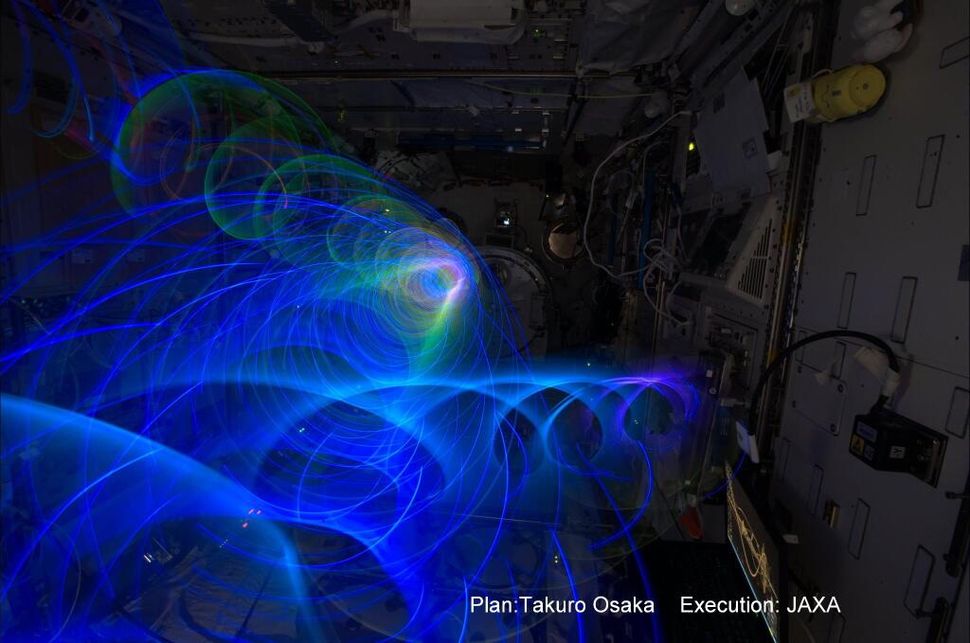
Art installations were also made on zero-g flights. For example there were two art projects on the 10. DLR parabolic flight campaign. One was an installation with marbles, called Zero-G Sculptures, the other was the Cloud Core Scanner.

The Arts Catalyst also has initiated installations on zero-g flights, mostly on their own campaigns in Russia.


Literature

One of the first to claim the subject was probably Jules Verne in his novel "Voyage round the moon", in which he described the onset of weightlessness and its effects on the passengers of his space ship. He already gave the impression that he sees weightlessness as an exhilarating state and he let his protagonists enjoy their experience.

But mostly zero-g was only a side effect in many science fiction stories and novels because it fit into the story. I got this impression for example when reading Perry Rhodan. Only a few stories make weightlessness the main subject of the story.

Exceptionally standing out I hereby find the novellas "Stardance", "Starseed" and "Starmind" written by Jeanne und Spider Robinson. They address the connection of dance and weightlessness and the longing of man for freedom of movement as their main subject (an abstract of their novellas can be found here).

Another book, this time a thriller, that makes weightlessness its main subject ist "Solar station" by Andreas Eschbach. This thriller is set on a station in space which collects solar energy, to beam it down to earth to satisfy its energy needs.

Many other examples can be found in old and new sci-fi short stories.


Music

For Charles Wilp music always was "the most weightless of all arts"...

Since Stanley Kubricks movie "2001" the waltz is associated with the feeling of weightlessness. But there are also artists who have used weightlessness as inspiration for their music. Sometimes I even have the impression they tried to illustrate the feeling of weightlessness in their music in a way to evoke this feeling also in their listeners or dancers. Artists and records of this kind are quite too many as for me giving names and titles here. But I think that in Techno/Trance, New Age, meditation music and many other genres everyone could discover titles when he searches for them...

Last but not least it is up to oneself if he can find music which can at least give him an impression of what floating in space might be like. I would not wonder if man has yet been able to get himself into a feeling of floating with the help of music and trance techniques throughout centuries or even millenia. And thus the longing to live it for real was created. A possibility which now, in this millenium, has come within reach for everyone.


Dance

Kitsou Dubois is one of the first dancers to work in zero-g. She explored the human movement in weightlessness from her view as a dancer and out of this developed proposals for astronaut training.

Only for the sake of artistic display Jeanne Robinson is a precursor of dance movement in weightlessness. She dealt with it already in the early 80s through a connection of dance and space and created the piece "Higher Ground". This piece contained at the end a sequence simulating zero-g. She was to be the first dancer to fly in space with a Space Shuttle with the NASA "Civilian in Space" Programme, to dance in zero-g. But this opportunity vanished when the Space Shuttle Challenger exploded. 2007 she got a new change to fly in zero-g, this time sponsored by Dr. Peter Diamandis and the Zero-G Corporation, to take part in a parabolic flight. Because she now is a choreographer, she took one of her dancers with her to do the dance part. The following clip was recorded on this flight:


Another dancer in zero-g is Morag Wightman, she showed a dance performance in weightlessness in a campaign run by "The Arts Catalyst".


Stage art / Theater / Performance Art

On stage many artists have tried to give the illusion of weightless floating. Be it illusionists having people "float" on the stage, artists on the flying trapeze in circus or "weightlessness" through the help of harnesses for creating three-dimensional dance or to bring float elements into a play.

1999 however brought a theater piece into weightlessness for real. This was Dragan Zivadinov and his Cosmokinetic Cabinet Noordung - named after Herman Potocnik Noordung (1892 - 1929), the author of the book "The problems of space travel". He went on a zero-g flight with a russian Ilyushin IL76MDK training aircraft of the cosmonaut center, with 6 actors and 8 spectators. His play is abstract, his thought behind it to remove it from regular stage and to let the border between spectators and actors disappear. This is also the reason why he allowed his spectators to get off from their seats and float freely in the realm together with the actors.

A nice example for performance art in zero-g is the Zero Genie by Ansuman Biswas.


Film

As already stated for the literature, in movies very often zero-g is only side effect, either to demonstrate the heroes are in space or, as happened in "Star Trek", to dramatize a story line and to show that something is going wrong. Mostly on science fiction starships there is normal gravity (probably to make the shooting easier, or maybe earlier on it was thought thant man cannot live in zero-g for the long times people are in space in sci-fi stories).

The new project of Jeanne Robinson is very different from that: She plans to put into film the Stardance Trilogy (see "Literature" and "Dance"), more information can be found here. This is probably the first movie where weightlessness is the main subject, even if as picturization of a novel.

Further beginnings can be found in several video clips. Examples can be found here.

By the way more and more frequently zero-g flights are used to shoot weightless scenes in movies. This way of working has turned out to be significantly easier than the simulation through wire harnesses.